103
Jul 19
Tap to Start Live Broadcast
Acoustic Enhanced Speech & Dynamic Visual Stream
As NASA selects astronauts for a moon mission, a Nigerian journalist explores the stark contrast between global space exploration and Nigeria's pressing local struggles with governance, poverty, and youth unemployment.
Intro: Imagine you're stuck in the legendary Lagos traffic, the air thick with exhaust fumes and the incessant symphony of blaring horns. Your generator, faithful companion in unreliable power, is sputtering its last, and the price of 'garri' just took another audacious leap at the local market. This isn't a hypothetical scenario; it's the raw, unvarnished daily reality for millions of Nigerians. Now, from this very grounded, very immediate struggle, pause for a moment. Far, far away from our pothole-ridden streets, our flickering streetlights, and our crumbling infrastructure, another reality is unfolding, one that seems almost impossibly distant: humanity is meticulously preparing to return to the Moon.
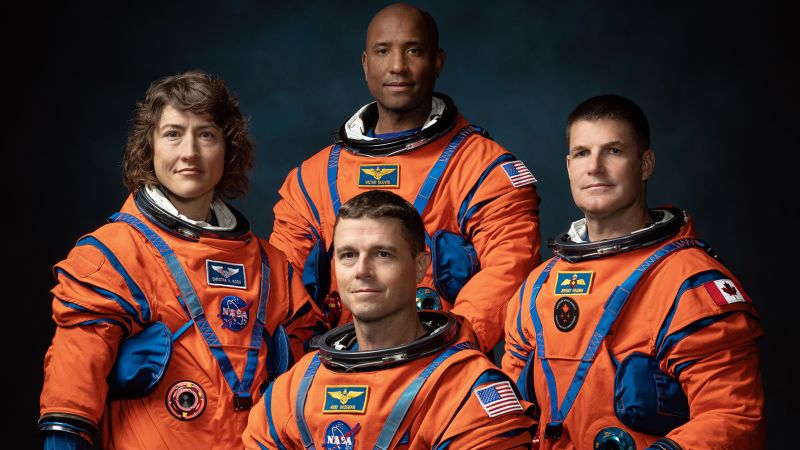
NASA, the formidable American space agency, recently made headlines across the globe, announcing the four intrepid individuals chosen to embark on the first crewed mission to the Moon in over half a century. This isn't just a leisurely orbital flight; it's a monumental undertaking, set to commence as early as November 2024, involving a lunar flyby christened Artemis II. The selected quartet – NASA's own Reid Wiseman, Victor Glover, Christina Koch, and Jeremy Hansen from the Canadian Space Agency – are not just names; they are seasoned professionals: decorated naval aviators, test pilots, electrical engineers, and space veterans, each bringing a wealth of experience to this historic journey. Their mission will see them travel beyond the Moon, potentially further than any human has ever journeyed, a harrowing 10-day odyssey aboard the Orion spacecraft, propelled by the colossal Space Launch System rocket from NASA’s Kennedy Space Center in Florida. This entire endeavor is a profound testament to human ingenuity, perseverance, and, crucially, an absolutely colossal investment of resources and intellectual capital. But as we, here in Nigeria, digest the news of these incredible feats unfolding on the global stage, a pressing question resonates with a particular urgency: what exactly does a 'giant leap for mankind' truly signify for a nation that often feels like it's still grappling with the most fundamental steps on terra firma?
'Moon mission? Abeg, make dem fix our roads first!' chuckled Mama Ngozi, a market woman in Surulere, wiping sweat from her brow. 'What is moon doing for my children's school fees? These Oyinbo people have too much money to burn, while we here are burning kobo just to eat and keep the lights on – sometimes!'
The news of the Artemis II mission is undeniably exhilarating, a powerful reminder of what humanity is capable of achieving when united by a grand vision and bolstered by immense, unwavering resources. Yet, for us, it simultaneously casts a stark, almost painful, light on the vast chasm that separates the developed world's ambitious aspirations from our own everyday realities. While nations like America and Canada are allocating billions towards the ambitious frontier of space exploration, Nigeria, tragically, remains embroiled in a seemingly endless battle against existential crises. Our public universities, the very bedrock of our future, are plagued by incessant strikes, systematically crippling the academic trajectory and career prospects of our eager youth. Our healthcare system, when not teetering on the brink of collapse, is chronically underfunded and severely understaffed, compelling many, particularly the affluent, to embark on expensive 'medical tourism' abroad. Our foundational infrastructure, from the erratic power supply that cripples businesses to the dilapidated transportation networks that impede commerce and daily life, remains a perennial source of profound frustration and an undeniable economic bottleneck. The 'brain drain,' a silent, insidious hemorrhage of our brightest and most promising minds, sees countless Nigerian doctors, engineers, and scientists reluctantly depart our shores for 'greener pastures,' often inadvertently contributing their exceptional genius and expertise to the very nations pioneering these grand space ventures. Imagine, for a moment, the collective genius, the meticulous planning, and the staggering financial resources currently powering Artemis II. Now, dare to imagine if even a fraction of that concentrated focus and funding were judiciously directed towards revitalizing Nigeria's crumbling power grid, or comprehensively equipping our vocational schools, or making sustained, robust investments in local research and development initiatives. The ripple effects for sustainable job creation, the much-needed economic diversification, and the genuine empowerment of our teeming youth would be nothing short of transformative. It is not about condemning the pursuit of space exploration; rather, it is about critically questioning our own national priorities and confronting the governance failures that seem to keep us perpetually playing catch-up in a world that is hurtling forward.
For the average Nigerian citizen, news of a distant moon mission, while intellectually captivating for some, often feels utterly divorced from the grinding realities of their daily struggle for survival. It does not magically put food on the family table, it offers no immediate solution to the persistent fuel scarcity, and it certainly does not guarantee a semblance of security on our increasingly perilous roads. The ordinary man or woman on the street is far more preoccupied with the relentlessly fluctuating price of petrol, the escalating cost of essential foodstuffs at the local market, or the Herculean task of simply affording quality education for their children in a system that demands more than it gives. When our national economy is bleeding, when inflation is relentlessly gnawing at the already diminished purchasing power of the naira, and when youth unemployment stubbornly remains at alarming levels, the grand narrative of distant lunar voyages can feel like a profound, even cruel, irony. The fundamental question here isn't whether Nigerians appreciate scientific advancement – many undoubtedly do – but whether we can genuinely afford the luxury of dreaming big when our most basic, fundamental needs remain woefully unmet. What we primarily observe are colossal missed opportunities. Our vibrant, teeming youth, brimming with raw potential and untapped talent, could be the next generation of innovators, engineers, and scientists, poised to contribute meaningfully to our national development. Instead, a disheartening number are forced into precarious, exploitative informal jobs, or worse, succumb to the pervasive societal ills due to a glaring lack of viable pathways for advancement and fulfillment. The brain drain isn't merely about highly skilled doctors or IT professionals leaving; it's about the systemic erosion of a potential scientific and technological workforce that could, and should, be driving Nigeria's own 'Artemis' – an ambitious, homegrown national development plan meticulously designed to tackle our most pressing, immediate challenges head-on. Our government's often myopic focus on short-term political gains frequently overshadows the critical, long-term strategic investments that are absolutely essential to truly building a nation capable of achieving its own self-defined 'giant leaps.'
For Nigeria to truly, meaningfully participate in the global march of progress, to stand shoulder-to-shoulder with nations that reach for the stars, we must, with utmost urgency, address and solidify the very foundations of our nation right here at home. This is not about stifling ambition or curtailing dreams, but rather about a critical re-prioritization of that ambition. We are in dire need of robust, accountable governance that demonstrably prioritizes fundamental sectors like education, healthcare, infrastructure, and crucially, strategic scientific research. We need consistent, sustained investment in our prodigious local talent, actively cultivating environments where our brilliant scientists and engineers can not only thrive but also see a viable, rewarding future without feeling compelled to seek opportunities abroad. Imagine, for a moment, a revitalized Nigerian space agency, not necessarily aiming for a lunar landing tomorrow, but acutely focused on developing practical satellite technology for vastly improved agricultural planning, efficient disaster management, or significantly enhancing national security and communication. Imagine a vibrant, dynamic ecosystem of innovation where government policies actively, unequivocally support local tech startups, indigenous scientific endeavors, and home-grown entrepreneurial spirit. We desperately require unwavering transparency and uncompromising accountability in public spending to ensure that our collective national wealth is scrupulously used for the common good, rather than shamelessly siphoned off into private pockets. The dream of space exploration is, without a doubt, a universal human aspiration, but a nation must first meticulously secure its terrestrial stability and foster widespread prosperity before it can confidently, genuinely reach for the distant stars. Until that fundamental shift occurs, while others gaze with awe at the moon, millions of Nigerians will, unfortunately, continue to gaze anxiously at the sky, hoping for steady, uninterrupted electricity, a roof that doesn't leak during the torrential rains, and a future that promises to be significantly brighter and more secure than their present. It is high time for our leaders to internalize and act upon the profound understanding that true national pride is not merely found in grand, fleeting pronouncements, but in the tangible, daily improvements to the lives of every single Nigerian citizen. Let us, as a nation, begin the arduous but essential work of building our own launchpad right here, on Nigerian soil, for a future that our youth can not only inherit but passionately inhabit and powerfully propel forward.