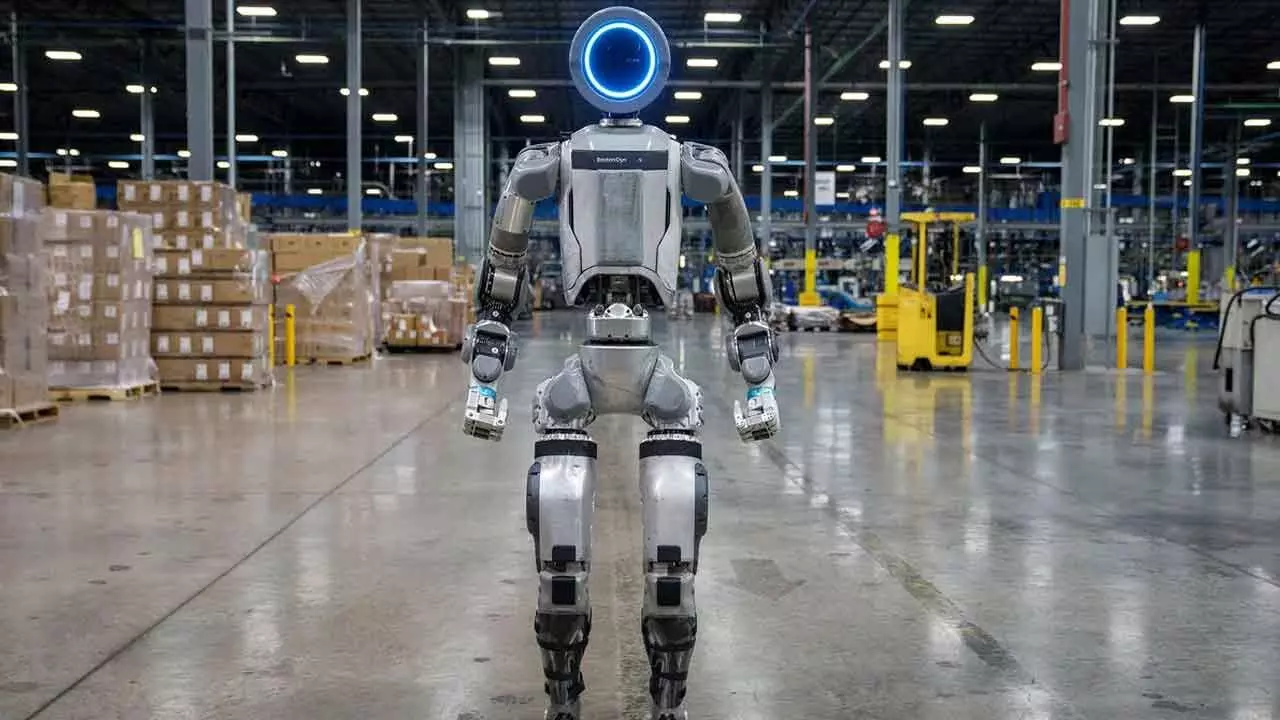
Google DeepMind has officially unveiled Gemini Robotics-ER 1.6, a monumental upgrade to its reasoning-first model designed to imbue physical AI with unparalleled spatial reasoning and autonomy. Launched on April 14, 2026, this iteration marks a significant stride in bridging the chasm between digital intelligence and real-world physical action, promising to redefine the capabilities of robots across diverse industries. The model's core innovation lies in its 'embodied reasoning,' enabling robots to not just follow instructions, but to truly comprehend and interact with their complex physical surroundings with unprecedented precision.

Revolutionizing Robotic Perception and Decision-Making
Gemini Robotics-ER 1.6 specializes in a suite of critical capabilities for robotics, including advanced visual and spatial understanding, sophisticated task planning, and reliable success detection. It significantly enhances multi-view understanding, allowing robots to seamlessly integrate data from multiple camera streams—such as overhead and wrist-mounted feeds—to form a coherent and dynamic picture of their environment, even amidst occlusions or changing conditions.
A standout feature is its newly introduced instrument reading capability, which enables robots to interpret complex gauges, sight glasses, and digital displays, a crucial skill for industrial and domestic applications. This advancement was developed in close collaboration with Boston Dynamics, further solidifying its real-world applicability.
'For robots to be truly helpful in our daily lives and industries, they must do more than follow instructions; they must reason about the physical world.'
— Laura Graesser and Peng Xu, Google DeepMind
The model acts as a high-level reasoning engine, equipped with agentic capabilities that allow it to break down complex, multi-step tasks into manageable subtasks. It can natively call external tools, including Google Search for information, Vision-Language-Action (VLA) models, or other third-party user-defined functions, dramatically extending its problem-solving scope.

Unparalleled Performance and Safety Standards
Benchmarks reveal that Gemini Robotics-ER 1.6 demonstrates significant improvements over its predecessors, Gemini Robotics-ER 1.5 and Gemini 3.0 Flash, particularly in spatial and physical reasoning tasks such as pointing, counting objects, and ensuring task success. A critical leap has been observed in instrument reading accuracy, which has reportedly improved from 23% in earlier models to as high as 93% with its advanced agentic vision capabilities.
Moreover, safety has been a paramount concern in its development. Gemini Robotics-ER 1.6 is touted as Google DeepMind's safest robotics model to date, exhibiting superior compliance with Gemini safety policies on adversarial spatial reasoning tasks and a substantially improved capacity to adhere to physical safety constraints. This includes making safer decisions regarding object manipulation based on gripper or material limitations (e.g., 'don't handle liquids' or 'don't pick up objects heavier than 20kg').
The model also supports multiple embodiments, adapting to a diverse array of robot forms, from bi-arm static platforms like ALOHA and Bi-arm Franka to humanoid robots such as Apptronik's Apollo. This versatility enables a single model to be utilized across various robot types, accelerating learning and generalization of skills. DeepMind's prior research into robot dexterity, such as the ALOHA Unleashed and DemoStart projects, laid foundational groundwork, showing how robots could learn complex multi-fingered and two-armed manipulation tasks from fewer demonstrations, achieving over 98% success rates in simulations for tasks like reorienting cubes.
Performance Comparison: Key Robotics Capabilities
Comparative performance of Gemini Robotics-ER 1.6 vs. previous models (Illustrative based on reported improvements).
This chart visually represents the reported significant improvements of Gemini Robotics-ER 1.6 across crucial metrics when compared to its predecessors.
A New Frontier for AI-Powered Robotics
The release of Gemini Robotics-ER 1.6 marks a pivotal moment for the robotics community, making these advanced capabilities accessible to developers via the Gemini API and Google AI Studio. This move is expected to foster rapid innovation and deployment of more autonomous and intelligent physical agents across various sectors. Partnerships, such as the ongoing collaboration with Boston Dynamics for their Spot robot and the new integration with Agile Robots for industrial applications, underscore the immediate and tangible impact of this technology.
As robots transition from merely executing programmed tasks to engaging in genuine embodied reasoning, the potential for transformative applications in manufacturing, logistics, healthcare, and even scientific discovery expands exponentially. DeepMind's continued focus on safety, combined with these significant leaps in spatial understanding and autonomous decision-making, positions Gemini Robotics-ER 1.6 as a foundational technology driving the next generation of physical AI, bringing us closer to a future where robots can intelligently navigate and contribute to our world.